This article was featured in the 2025 Autumn Newsletter by Ashley Ballou, New York Natural Heritage Program.
Vernal pools, wetlands that can be difficult to find and are often overlooked, play an important role in a healthy New York forest ecosystem. These wetlands are usually small and shallow, are flooded for a few months in the spring, and lack fish, but they provide habitat for countless species throughout the year.

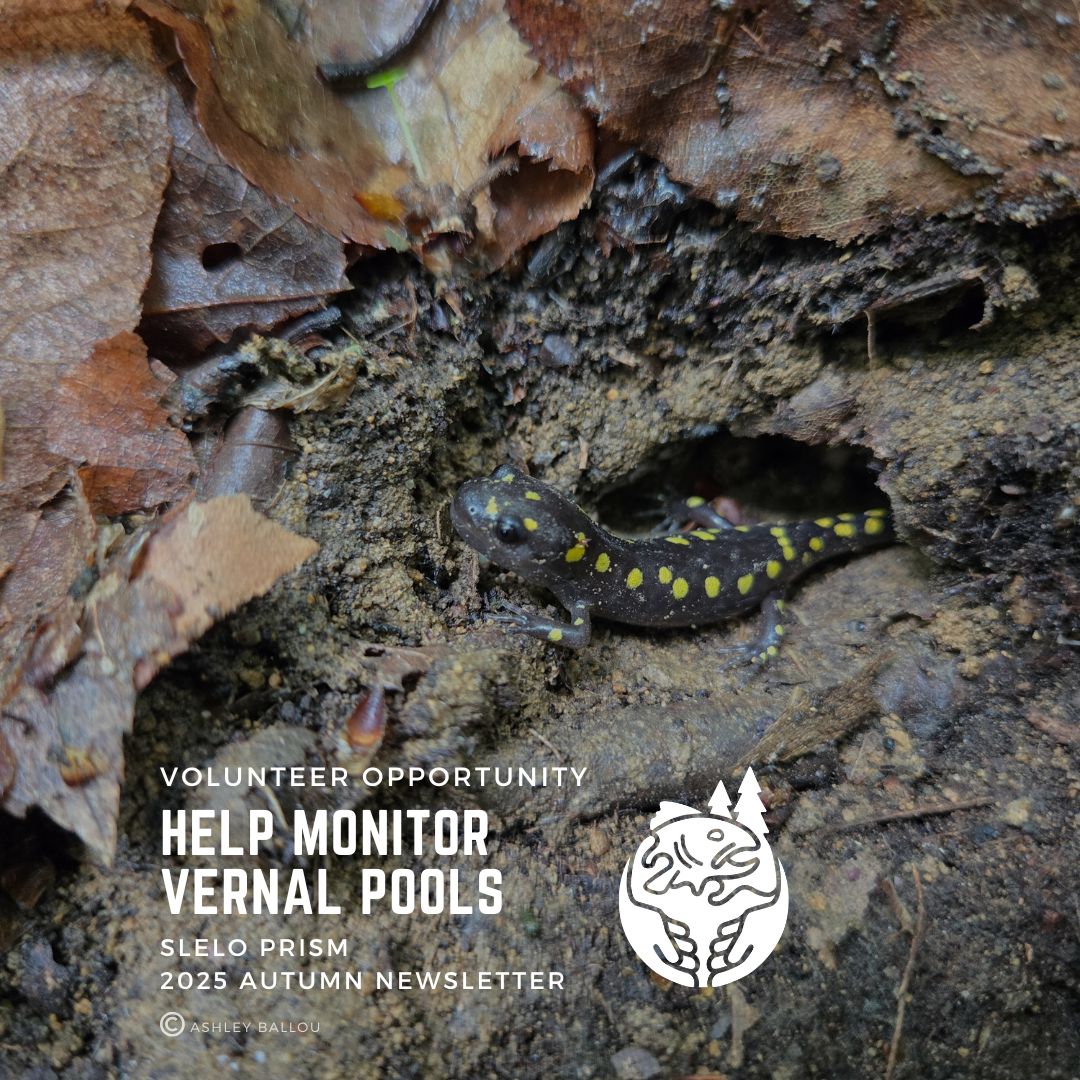
Species such as Spotted Salamanders (Ambystoma maculatum), Jefferson Salamanders (Ambystoma jeffersonianum), and Wood Frogs (Lithobates sylvaticus) use the flooded pools in the spring to lay their eggs, and the pools stay wet long enough for them to hatch and metamorphose. Since vernal pools eventually dry out, fish are unable to maintain populations in these wetlands, enabling amphibian eggs and larvae to develop without a high rate of predation. Countless other species, such as marbled salamanders (Ambystoma opacum), fairy shrimp, and turtles, use vernal pools throughout the year for breeding, feeding, and shelter.

Despite the important role vernal pools play in our landscape, there is still much to learn about them because these small landscape features can be difficult to locate and conserve. The New York Natural Heritage Program (NYNHP) is working with organizations in Great Lakes states to increase knowledge of vernal pools using new mapping tools, and recruiting volunteers for a new community science program called NY POOLS! Remote sensing will be used to identify potential vernal pools in the Western, Northern, and Capital regions of New York.
The northern focal region for this project is within Jefferson and St. Lawrence counties and overlaps with much of the SLELO region. Community scientists will be trained using a combination of webinars, training manuals, and in-person workshops beginning in 2026. Volunteers will be assigned potential pools based on their location and availability, and they will be asked to visit up to three times throughout the year to verify that the site is a vernal pool and to monitor for breeding amphibians and other important species. Data collected by volunteers will be used to increase our knowledge of vernal pool productivity throughout the state, expand a database of New York’s vernal pools, and test the accuracy of new mapping tools.
NYBNHP welcomes participation from volunteers with any level of knowledge about vernal pools! Sign up to become a volunteer for NY POOLS or to be added to an email list by filling out this online form. If you’re interested in this opportunity, reach out to Ashley Ballou at Asley.Ballou@dec.ny.gov.
Please fill out the form below to be added to our listserv and receive our seasonal newsletter, event invitations and other announcements.

