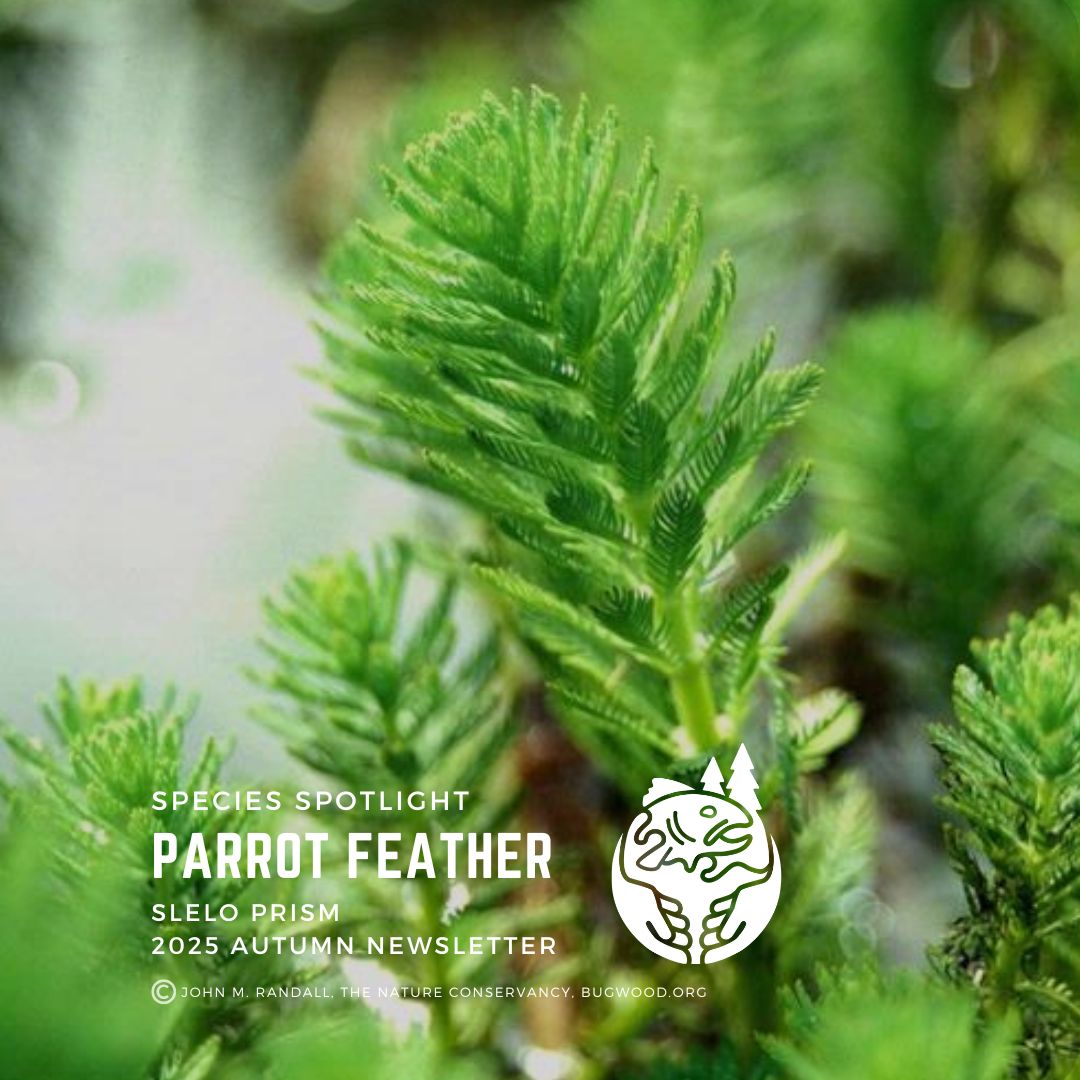
This article was featured in the 2025 Autumn Newsletter by Adrien Owens, SLELO PRISM.
Myriophyllum aquaticum, commonly referred to as Parrotfeather, is an aquatic plant native to South America. Spread by human dispersal, mainly by the aquatic plant trade for aquaria and garden ponds, Myriophyllum aquaticum has spread invasively across at least 26 states in North America and around the world. Once established in a new environment, the plant easily spreads downstream in the form of vegetative fragments or attached to ships or boats. There are only female plants in North America, meaning there are no seeds produced from the plants in the United States. The foliage dies off in winter, and the roots produce new shoots in the spring.
Parrotfeather population in a waterbody. Photo credit, Leslie J. Mehrhoff, University of Connecticut, Bugwood.org.
How to Identify: Myriophyllum aquaticum is a rhizomatous aquatic perennial that has both submerged and emergent feathery leaves that appear in whorls along their stems, which can grow up to 6 feet long. Submerged leaves are 0.6-1.4 in. long and have 20 to 30 divisions per leaf. Submerged foliage is chartreuse in color. The stems and leaves of parrotfeather can stand nearly a foot out of the water. Emergent leaves are stiff, in whorls of four to six, pinnately compound, and finely divided into ten or more thread-like sections. Emergent leaves are 0.8-2 in. long, less divided and dark blue-green, much different than submerged leaves. Small yellow-green flowers bloom in summer from the leaf axils of emergent stems.
Parrotfeather stalks. Photo credit, Leslie J. Mehrhoff, University of Connecticut, Bugwood.org
Parrot feather population. Photo credit, Graves Lovell, Alabama Department of Conservation and Natural Resources, Bugwood.org
Parrotfeather stem and leaflets. Photo credit, Rebekah D. Wallace, University of Georgia, Bugwood.orgjpg
Significance: Despite being invasive in many regions, Myriophyllum aquaticum is still commonly sold as a water garden plant, which has the potential to escape into local waterways. Parrotfeather can be found in freshwater lakes, ponds, and canals with slow-moving waters. This invasive plant competes with native aquatic plant communities, forming dense mats that can entirely cover the surface of the water providing habitat for mosquitos.
Parrotfeather is a Tier-1 species, meaning it is not known to be present within our region but it is within a 100 mile radius, or a clear pathway exists. An established population of parrotfeather was found by the Finger Lakes PRISM in Onondaga County in 2025. Once established, control of this plant is extremely costly, making early detection a critical measure to protect our region’s native plant diversity and access to our waterways.
If you think you may have found parrotfeather please report it to NYiMapInvasives. If you are unable to report sightings directly to iMap, please send clear, up-close photos of the plant and GPS coordinates of the location to Adrien.Owens@tnc.org.
Parrotfeather in nursery. Photo credit, Leslie J. Mehrhoff, University of Connecticut, Bugwood.org.