Protector’s Activity: Species You Can Spot This Season
December 11, 2025
What's The Issue?
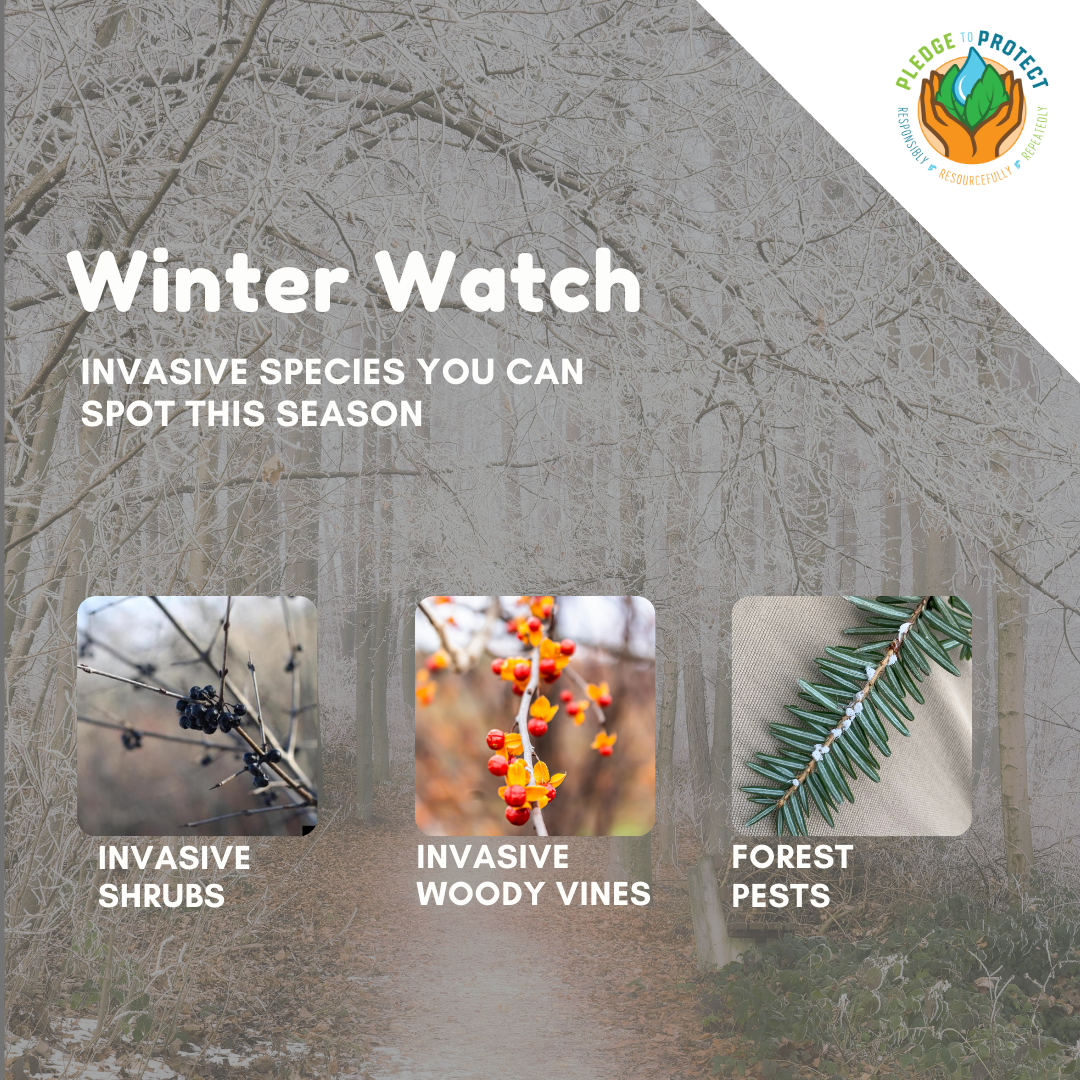
Winter isn’t just for cozy fires and snowy hikes; it’s also the perfect time to spot invasive species that threaten our forests, lands, and trails. Many invasives have unique traits, such as persistent berries, lingering leaves, distinctive bark, or egg sacs, that make them stand out in the cold months. These conspicuous traits provide an opportunity to identify and report them. Below are examples of invasive shrubs, vines, and forest pests you may encounter this season, along with some prevention and management tips.
What Can Be Done?
Review this blog and watch the webinar below to learn to identify invasive species.
Report observations to the NYiMapinvasives free mobile app or online platform.
Take suggested actions to prevent the spread of invasive species.
Manage invasive species found on your own property.
Invasive Woody Shrubs & Vines
Shrubs like invasive barberry, honeysuckle, and buckthorn form dense thickets that outcompete native plants, reduce biodiversity, and alter soil conditions. They also create humid shelters that attract deer and mice—major tick hosts—and provide poor-quality berries for birds.
Invasive woody vines like porcelain berry and bittersweet choke native trees by strangling trunks, blocking sunlight, and adding weight that causes breakage. Oriental bittersweet also hybridizes with native American bittersweet.
Prevention Tips:
Avoid planting invasive shrubs and vines.
Clean gear to prevent spread.
Monitor disturbed areas.
Garden and landscape with native plants.
Management Tips:
Cut new growth before seeding and bag debris.
Cover low-laying invasive plants with landscape barriers in early spring.
For established plants, use repeated cutting/pulling or apply selective herbicides to cut stumps.
Identification and Winter Survey Tips
Invasive Barberry (Berberis thunbergii)
Look for thorny arching stems and small red berries that persist through winter.
Berberis thunbergii. Credit Leslie J. Mehrhoff, University of Connecticut, Bugwood.org
Berberis thunbergii branch. Photo Leslie J. Mehrhoff, University of Connecticut, Bugwood.org
Look for vertically grooved, striped bark; hollow stems; and paired red berries that often linger through winter.
Honeysuckle branches. Photo iMapInvasives
Honeysuckle berries. Photo iMapInvasives
Honeysuckle bark. Sophia Photo Chapin Bugwood.org
Honeysuckle bark. Photo iMapinvasives
Common & Glossy Buckthorn ( Frangula alnus, Rhamnus cathartica)
Identify common buckthorn by short thorns at branch tips and along mature stems. Its bark becomes rough with age, lenticels fade, and scraping reveals a yellow-orange inner layer. Glossy buckthorn doesn’t grow thorns and has smooth gray bark with prominent white lenticels. Both species may hold clusters of black berries through winter, though berry color varies in summer.
Common Buckthorn. Photo Rob Routledge Sault College Bugwood.org
Common buckthorn branch and thorns. Photo iMapinvasives.
Common buckthorn branch. Photo iMapInvasives.
Berberis thunbergii branch. Photo Leslie J. Mehrhoff, University of Connecticut, Bugwood.org
Glossy buckthron bark. Photo Chris Evans, University of Illinois, Bugwood.org
Glossy buckthorn berries. Photo Rob Routledge, Sault College, Bugwood.org
Common buckthorn. Photo John M. Randall, The Nature Conservancy, Bugwood.org
Porcelain Berry (Ampelopsis brevipedunculata)
Look for colorful speckled berries—blue, purple, turquoise. Bark is light brown with raised pores (lenticels). Stems have a white pith (spongy core).
Porcelain berry bark. SLELO PRISM.
Porcelain berry VS grape. Credit Frank Hassler, Wisconsin.gov. bark.
Porcelain berry berries. Credit Leslie J. Mehrhoff, University of Connecticut, Bugwood.org
Porcelain berry pith. Credit Frank Hassler Wisconsin.gov
Invasive Bittersweet (Celastrus orbiculatus)
Look for vines wrapping tightly around trees, bright yellow capsules splitting to reveal red berries. Fruit forms along stems, unlike the native species, which hold fruit only at branch tips.
Invasive Bittersweet branches and berries. Photo iMapInvasives.
Celastrus orbiculatus. Photo Richard Gardner Bugwood.org
Celastrus orbiculatus bark. Photo Chris Evans, University of Illinois, Bugwood.org
Forest Pests
Hemlock woolly adelgid, and balsam woolly adelgid kill host trees through sap-feeding, causing needle drop, dieback, and mortality. Loss of trees alters ecosystems, reduces biodiversity, and impacts property values.
Prevention:
Practice Early Detection and Rapid Response (EDRR)
Report observations via NYiMapInvasives.org or their mobile app
Management:
Clean gear and avoid infested areas
For high-value trees, apply systemic insecticides (imidacloprid or dinotefuran) as soil drenches, basal sprays or trunk injections via a certified pesticide applicator.
For dense HWA infestations, release biocontrol agents like Laricobius beetles and Leucotaraxis silver flies. The New York State Hemlock Initiative has helpful management tips for hemlock woolly adelgid.
Identification and Winter Survey Tips
Hemlock Woolly Adelgid-HWA (Adelges tsugae)
HWA targets Eastern and Carolina Hemlock trees (Tsuga cnadensis, Tusga caroliniana). Look for white, woolly egg sacs on the undersides of hemlock branches where the needles connect.
Hemlock woolly adelgid in crawling stage under microscope. Photo dec.ny.gov.
Hemlock Woolly Adelgid. Photo Bruce Watt, University of Maine, Bugwood.org
Balsam Woolly Adelgid- BWA (adelges piceae)
BWA targets true firs Abies spp.; although Balsam fir (Abiesbalsamea) and Fraser fir (Abies frasieri) are most susceptible to severe damage. Look for white woolly spots on the bark, twig swelling (gout), and distorted crowns.
Balsam woolly adelgid. Photo Ronald S. Kelley, Vermont Department of Forests, Parks and Recreation, Bugwood.org
Needle discoloration caused by balsam woolly adelgid. Photo USDA Forest Service - Coeur d'Alene Field Office , Bugwood.org
Twig swelling caused by balsam woolly adeltid. Photo Ronald S. Kelley, Vermont Department of Forests, Parks and Recreation, Bugwood.org
Did you enjoy this blog post? Take our Pledge to Protect and get monthly emails showcasing actions you can take to protect your favorite hiking trails, paddleways, forests, garden, and community from the impacts of invasive species!
Take the Pledge to Protect
The Pledge-to-Protect is a fun, positive, inviting, engaging and rewarding way to participate in invasive species prevention and management.
Here’s How It Works:
Fill out the pledge form below and select the outdoor areas you spend the most time in.
Check your inbox for your confirmation email.
Explore the resources in the virtual toolkits or download the PDFs.
Earn a virtual badge for each pledge you take.
Every month, you’ll receive a special Pledge-to-Protect email about a prevention/management activity to help you fulfill your pledge OR a highlight of an invasive species to keep an eye out for.