This article was featured in the 2025 Autumn Newsletter by Jacob Leeser, Cornell University IPM.
Home gardeners and landscape professionals in the St. Lawrence Eastern Lake Ontario region should be on the lookout for a new invasive pest. The box tree moth (Cydalima perspectalis) has the capacity to quickly destroy boxwood plantings if not identified and treated. Boxwoods are popular evergreen landscape shrubs known for their deer resistance, shade tolerance, and their low-maintenance, slow-growing habit. They can be used in foundation plantings, low hedges or even topiaries and knot gardens.
Damage to boxwood shrubs due to box tree moth caterpillars. Photo credit, Cornell University IPM.
Box tree moth (BTM) first found its way to NY in 2021 along Lake Erie in Niagara County and has been slowly moving eastward. There are currently small populations near Lake Erie and the St. Lawrence River in Jefferson and St. Lawrence counties.
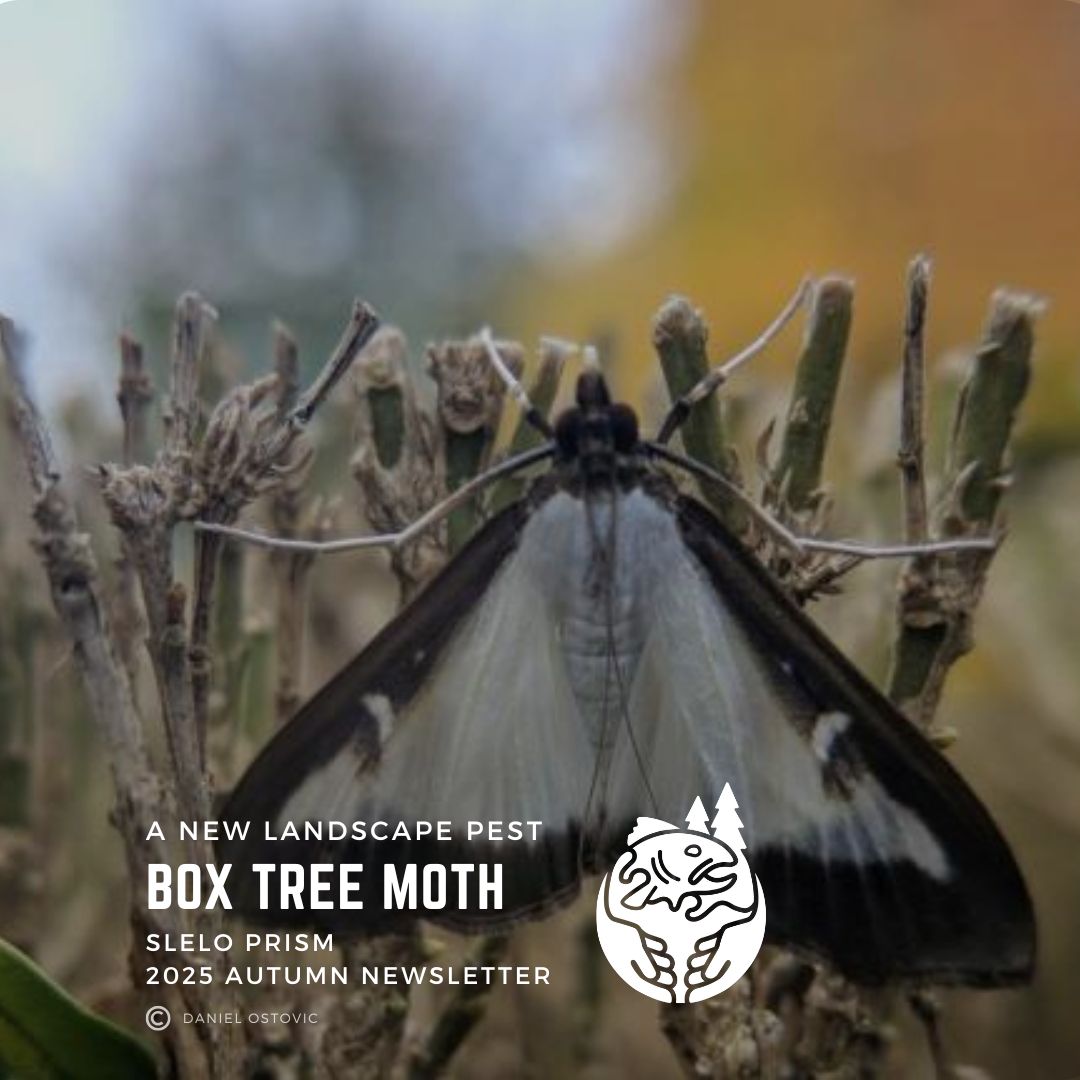
Box tree moth feeds on the foliage as a green caterpillar with a black head. They grow from a minute size at the time of hatching to over an inch long in as little as two weeks, at which point they will pupate into adult moths to mate and lay eggs. Moths are white with brown wing margins, with a crescent-moon marking through the brown margin useful for positive identification.
Only the caterpillars actively harm plants, which they do by feeding on the leaves. If left unmanaged, BTM can reproduce rapidly, completing up to three life cycles in a year. High populations can defoliate a boxwood thoroughly enough to kill the plant within weeks.
Adult box tree moth_Photo credit, Danijel Ostovic.
Box tree moth caterpillar. Photo credit, Cornell University IPM.
BTM caterpillars are clever enough to hide deep within the dense canopy of the boxwood. To survey for BTM, it is important to part the outer branches and inspect the center of the shrub. Look for the distinctive feeding patterns of BTM, where both sides of a leaf are eaten but the mid-stem remains intact. As with any invasive species, early detection and rapid response are the best methods to control BTM. If you suspect you have found box tree moth, please inform NYS Agriculture and Markets by reporting it to their online form.
Cornell IPM has BTM management resources on their Box Tree Moth webpage. Small populations can be controlled by hand-picking the caterpillars off shrubs. There are products registered in New York State for controlling this pest, including organic options such as neem oil and mineral oil. A full list can be found at this link.
For gardeners looking to circumvent this pest, Cornell IPM has composed a list of alternative plants. For questions about BTM and other invasive pests, contact Jacob Leeser, Cornell University IPM Program jl4353@cornell.edu.
Cornell University IPM staff searching for box tree moth on box wood shrub. Photo credit, Cornell University IPM.