
This article was featured in the 2026 Spring Newsletter by Matt Del Buono, New York Hemlock Initiative, Cornell University.
Across the eastern United States, eastern hemlock forests continue to decline under pressure from hemlock woolly adelgid (HWA), a tiny insect introduced on nursey stock from Japan. Hemlocks are a foundation species that shape forest structure, regulate temperature and moisture, and support unique plant and wildlife communities. Their loss alters entire ecosystems and protecting them requires management strategies that work at the scale of forests, not just individual trees.
A recent paper led by New York State Hemlock Initiative Research Technician Elizabeth D’Auria, published in the Journal of Insect Science, documents an important step forward in biological control of HWA. The study presents refined methods for collecting and rearing three specialist predators that cooccur naturally in the adelgid’s native western range: two silver flies, Leucotaraxis argenticollis and Leucotaraxis piniperda, and the predatory beetle Laricobius nigrinus. Together, these insects feed on HWA across multiple life stages and offer the potential for sustained population suppression.

Biological control depends on timing as much as it does on species selection. For predators to be effective, they must be released when HWA is producing eggs in late winter and spring. In the West, this timing occurs naturally. Recreating it in eastern North America requires reliable methods for sourcing predators and coordinating their development with adelgid phenology.
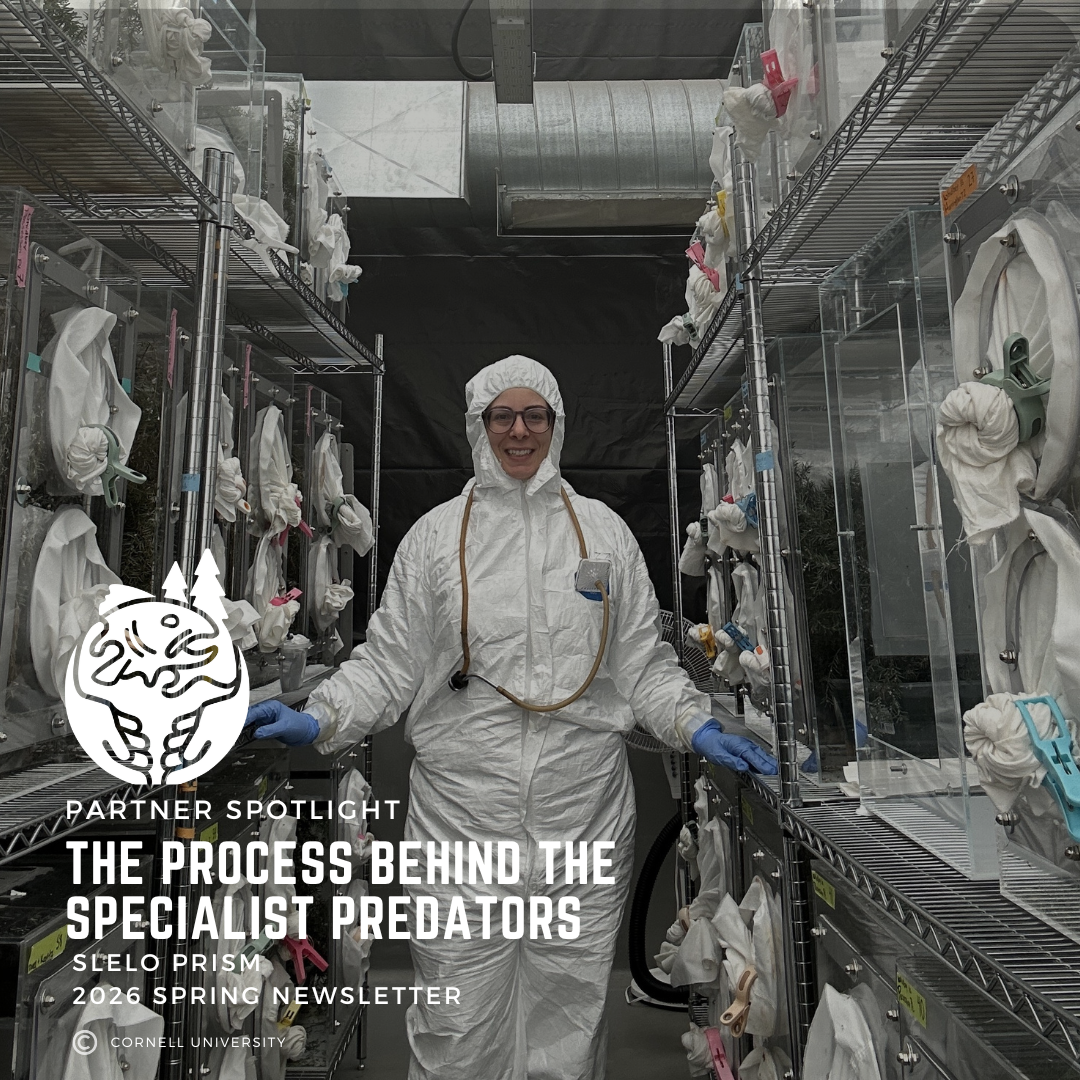
The approach described in this study blends field collection with controlled rearing. Each year, NYSHI staff collect HWA infested western hemlock branches from the Pacific Northwest and transport them to a USDA certified quarantine greenhouse in Ithaca, New York. Greenhouse temperatures are managed to accelerate predator emergence so that adults are available when eastern adelgid populations are most vulnerable. The facility ensures that only approved predator species proceed through the rearing process.
Inside the greenhouse, technicians rely on predator behavior to guide daily collections. Adult silver flies move upward toward light, while Laricobius larvae drop from foliage to pupate in soil. These predictable patterns allow insects to be collected efficiently and gently, then grouped by species, site, and date. The team refers to this combined field and laboratory approach as composite rearing.
Over years of study, patterns began to emerge. Collections made from March through May produced the highest numbers of all three predators, particularly the silver flies. Laricobius nigrinus larvae peaked in March, when adelgid egg production is highest. As methods were refined over time, beetle survival from larva to adult increased substantially, reaching nearly 70 percent in recent years.
Crucially, the study shows that all three predator species can be collected from the same sites during the same season without reducing abundance. By documenting these techniques, the NYSHI team provides a practical roadmap for producing predators predictably and at the right time of year. These methods now support field releases, ongoing research, and collaborations with partners in Virginia and Canada, strengthening long-term hemlock conservation efforts across the region. Learn more about the New York State Hemlock Initiative.
Please fill out the form below to be added to our listserv and receive our seasonal newsletter, event invitations and other announcements.

