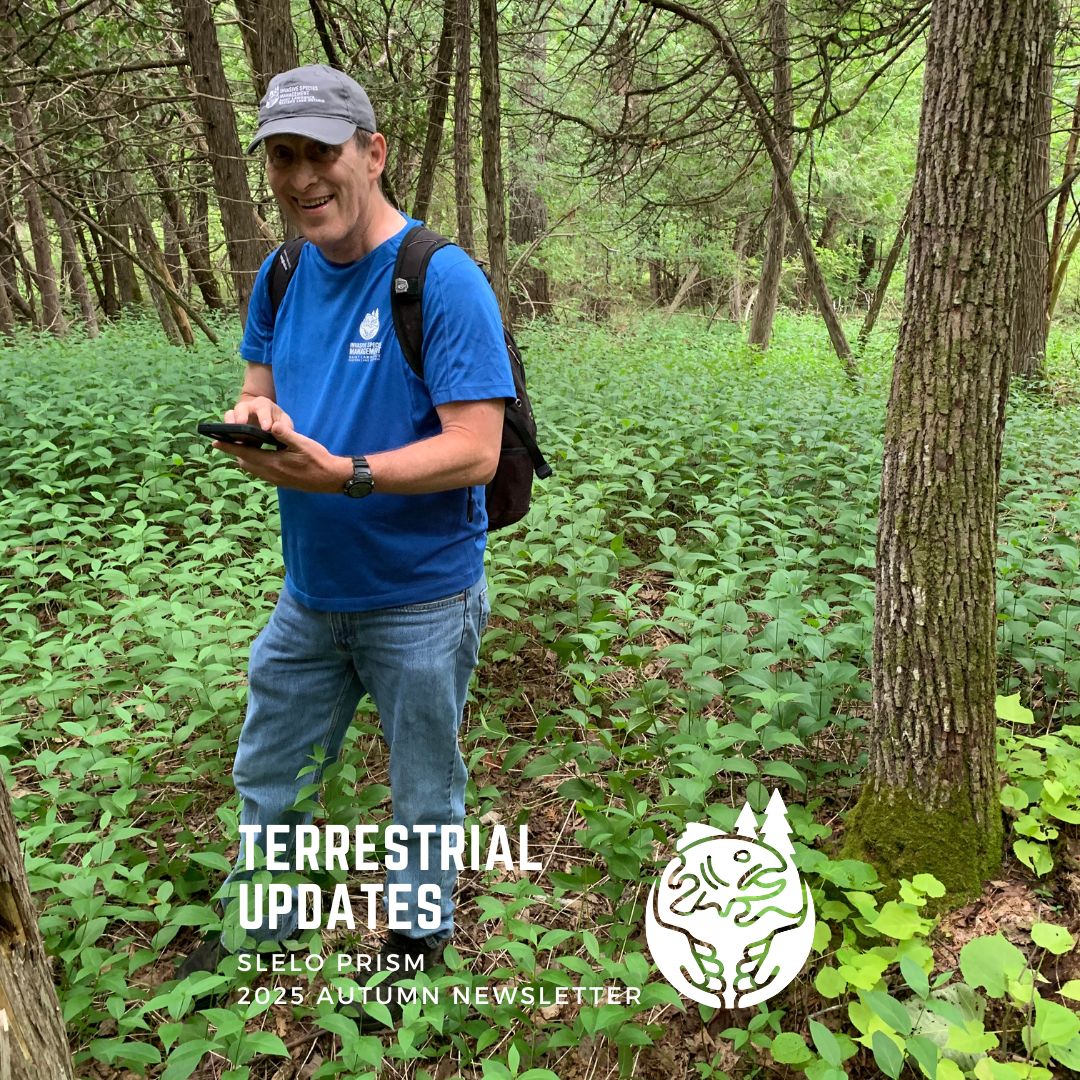
This article was featured in the 2025 autumn newsletter by Robert Smith-SLELO PRISM.
Emerald Ash Borer:
This summer was the 2nd year of the EAB Biocontrol Recovery/Establishment Survey at Rice Creek Field Station at SUNY Oswego. This survey involved placing 15 yellow pan traps on trees that had to be checked every week for 15 weeks. These traps attract and capture a wide range of insects, including the three parasitoid wasps released in 2022/23 as a biocontrol measure for the emerald ash borer.
Last year, SLELO Staff, partners, and volunteers found all three of the parasitoid wasps (Spathius galinae, Tetrastichus planipennisi, and Oobius agrili), while this year we found Spathius and Tetrastichus, but couldn’t find Oobius. According to the USDA, we have good evidence that Spathius and Tetrastichus are establishing, and Oobius may also be establishing, but needs further surveying to determine that.
We hope that these species will all become fully established and protect the young and uninfested ash trees at SUNY Oswego and the surrounding region.
2025 Symposium EAB Biocontrol Workshop attendees. Photo credit: Kelly Roe.
Pictured left to right: Robert Foster, Ann McGivney, Andrew Bird. Photo credit: Kelly Roe.
Spotted Knapweed:
In July and August, we released two species (400 in total) of weevils, approved as biocontrol agents for spotted knapweed, at Deer Creek WMA to help protect the fragile dune ecosystem along Lake Ontario. These species are Larinus spp., which target the flower/seed head, and Cyphocleonus Achates, which targets the roots.
Cyphocleonus Achates, a biocontrol agent that targets the roots of invasive spotted knapweed. Photo credit, SLELO PRISM.
Larinus spp., a bicontrol agent that targets the flower/seed heads of invasive spotted knapweed.
Fall 2025 Restoration Area Plantings: From October 20th-25th, SLELO PRISM, along with New York DEC and Parks Staff and 18 volunteers, planted nearly 1,400 plants at four restoration areas (Deer Creek WMA, El Dorado Preserve, Black Pond, and Selkirk Fen Preserve).
To support diversity, we selected 22 plant species, with up to 15 of each species planted at one restoration area. Resources such as iNaturalist, the New York Flora Atlas website, and the New York Natural Heritage Program’s Ecological Communities Guide were used to determine if each species was native and habitat appropriate for these sites.
Below are photos of the partners and volunteers who assisted restoration plantings. Photo credit, SLELO PRISM.
2025 Management Efforts Update:
44Giant Hogweed (Heracleum mantegazzianum):
• 73 Total Sites Monitored • 32 Sites with no germination • 3 Retired • 19 Sites root cut • 20 Sites herbicide treatment • 2 Sites with no permission to treat
Swallowwort (Vincetoxicum rossicum):
• 50 HPAs being managed • 10 PCAs • 169.46 Acres under management (HPA) • 36.39 Acres of Presence Area
Knotweed (Reynoutria japonica):
• 9 HPAs being managed • 5 PCAs • 7.32 Acres under management (HPA) • 2.33 Acres of Presence Area
Phragmites (Phragmites australis):
• 17 HPAs being managed • 10 PCAs • 30.67 Acres under management (HPA) • 3.8 Acres of Presence Area
Bittersweet (Celastrus orbiculatus):
• 4 HPAs being managed • 2 PCAs • 5.40 Acres under management (HPA) • 1.32 Acres of Presence Area
2025 Early Detection Surveys:
The 2025 Invasive Species Surveys were recently completed. Surveys were completed at approximately 117 Highly Probable Areas (HPAs) on 7 Priority Conservation Areas (PCAs), 35 of which have active treatments occurring and have been evaluated for post-treatment success. We found common invasive species such as pale swallowwort, phragmites, and invasive knotweed; no Tier 1 or 2 species were detected. More details will be included in our annual report. Native species surveys at these PCAs were also conducted to determine the best plants for restoration work.
2025 Biocontrol Updates:
Swallowwort: Establishment surveys for Hypena opulenta, the biocontrol moth for swallowwort, were conducted at Wehle State Park and Grenadier Island from June to August. Unfortunately, no moths or evidence of their presence were found at either site during these surveys. Based on the results of these surveys and those in years past, we will not be releasing or surveying for Hypena opulenta moths in the future. However, we will continue chemical and manual/mechanical management until another approved biocontrol is found.