
This article was featured in the 2026 winter newsletter by Nicholas Dietschler, Cornell University’s NYS Hemlock Initiative.
Why can some forest pest be destructive in one part of the world, yet relatively harmless in the place it comes from? Invasions by non-native forest pests leading to ecological impacts are often studied exclusively in their invaded range. However, important insights come from examining these species in their native range. Classical biological control (CBC), the use of specialist natural enemies, relies on expeditions to the native range to identify effective predators. Yet native range CBC research typically ends once biocontrol agents are collected, overlooking the broader ecological context in which the pest evolved. The recent paper Multitrophic interactions and niche partitioning in the native range inform biological control in forests invaded by the hemlock woolly adelgid, examined the predator–prey community associated with the hemlock woolly adelgid (HWA) through a biogeographical lens in its native western North American range.
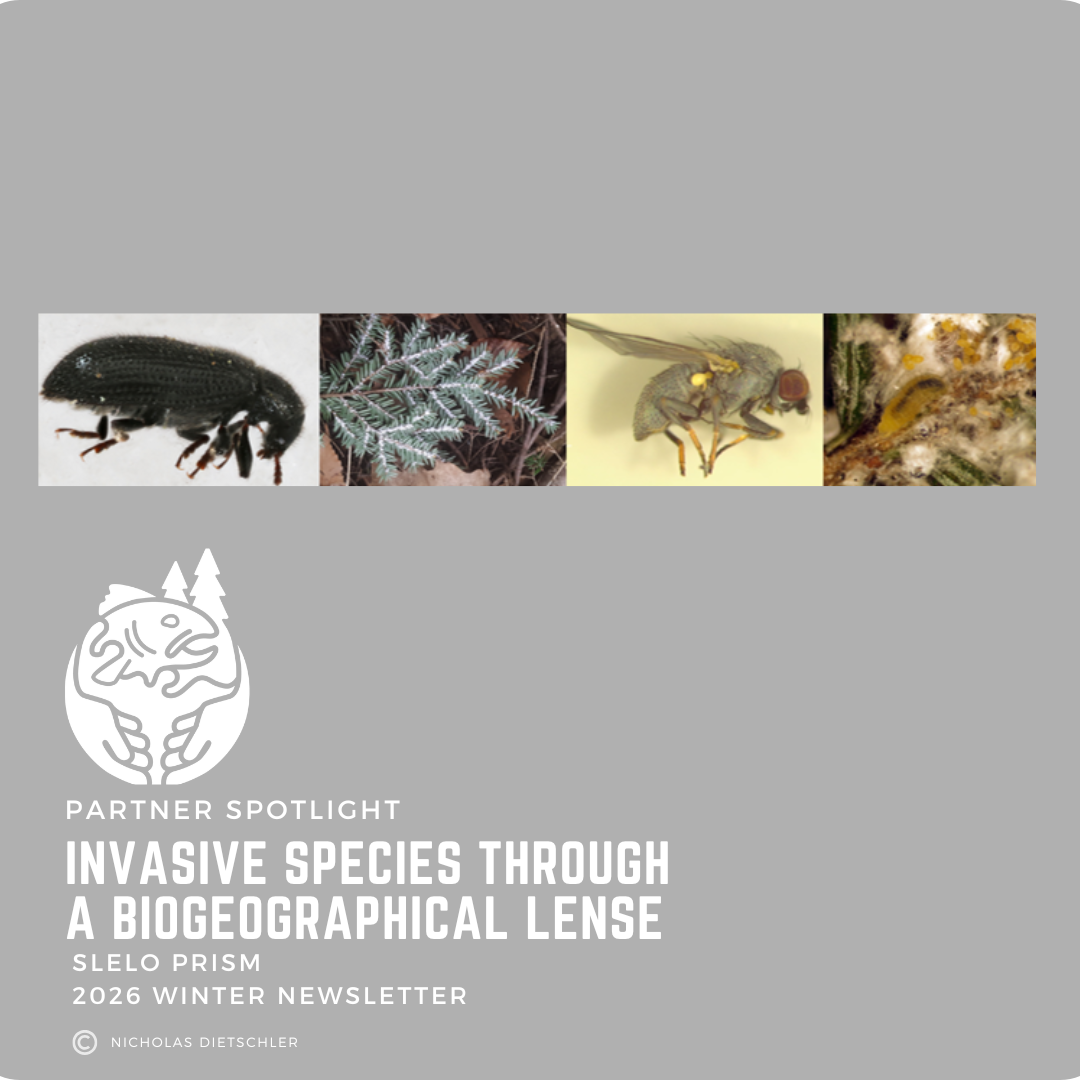
Hemlock woolly adelgid was introduced to eastern North America in the early 20th century from Japan and has since caused decline of eastern and Carolina hemlock forests. Interestingly, there are several distinct populations of HWA in Asia, and one in western North America. Predator collections from multiple native ranges have identified suitable biocontrols, and western North American HWA provide a unique opportunity for research into predator-prey interactions. In the west, predators that keep HWA populations in check include a beetle (Laricobius nigrinus) and two fly species (Leucotaraxis argenticollis and Le. piniperda). The goal of CBC is to replicate natural predator communities that regulate pests populations, and understanding native community interactions can support management. Cornell University’s NYS Hemlock Initiative conducts extensive research in western North America to inform management efforts.
Studying multi-trophic interactions, or more than one level in the food chain, gives researchers context of what keeps pest populations in check. Biocontrol programs use multiple predators targeting pests at key points, and the two fly species feed on HWA at different times, complementing each other in a biocontrol scenario. While the two fly species overlapped with the beetle predator, we found they were present on separate twigs, suggesting they are avoiding each other. Observations in the native range show predators feeding on HWA in harmony, but what if they are released together in the east? We put the two fly species into direct competition in the lab, and found the flies performed equally well when released together. The native western and introduced eastern HWA are closely related, but have observable differences. Adelgid in the invasive range has two generations per year, with western HWA fluctuating between one and two annual generations, with unknown impacts on their predators or hemlock host trees.
These studies provide valuable insights into invasive pest community dynamics that inform management efforts. HWA offers an example that can be replicated in other pest systems, and the study can be accessed in Biological Invasions.
Please fill out the form below to be added to our listserv and receive our seasonal newsletter, event invitations and other announcements.

