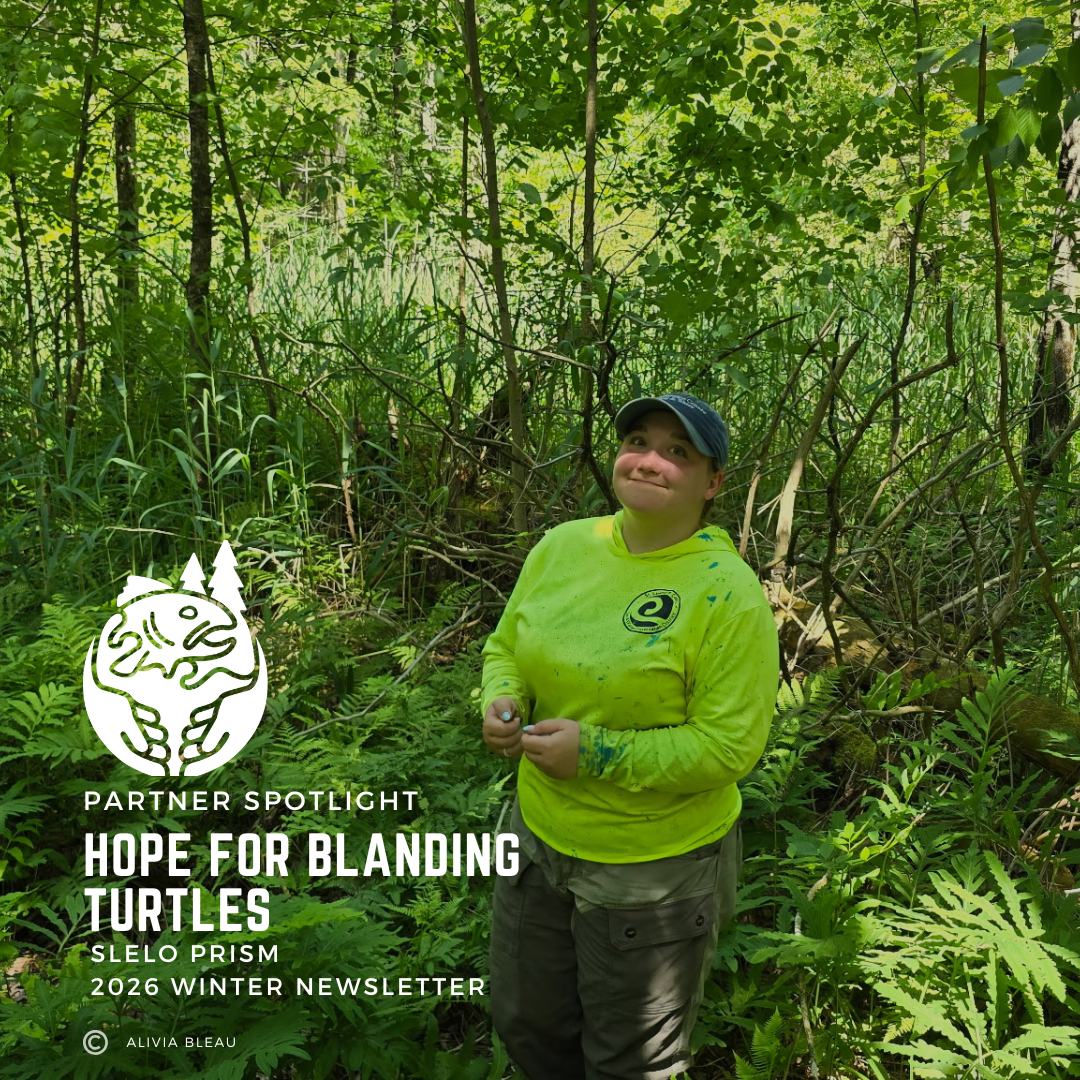
This article was featured in the 2026 winter newsletter by Alivia Bleau, St. Lawrence County Soil and Water Conservation District.
The Blanding’s turtle (Emydoidea blandingii) is one of New York State’s rarest turtles. Habitat loss, road mortality, and invasive species have all contributed to population declines across the state. They are found in only four limited populations in NYS, one in Saratoga County, one in Dutchess County, one in Erie County, and up North in Jefferson/St. Lawrence County. The Blanding’s turtle is a New York State Threatened Species.
Healthy wetlands are essential for Blanding’s turtles. They depend on shallow marshes, open water, and nearby upland areas for basking, feeding, and nesting. When these wetlands change, turtles feel the impact quickly. Especially as a long-lived species with delayed sexual maturity.
The habitat of the Blanding’s turtle is increasingly threatened by the spread of non-native invasive species, particularly Phragmites, honeysuckle, and buckthorn. These invasive plants have overrun critical wetland and upland areas, significantly degrading the quality of the Blanding’s turtle’s habitat by outcompeting native vegetation, altering water quality, reducing available food sources, and access to safe nesting sites. Phragmites, in particular, creates dense stands that outcompete native vegetation and reduce available food sources, while honeysuckle and buckthorn contribute to habitat fragmentation and a loss of biodiversity. The continued expansion of these invasive species threatens not only the Blanding’s turtle population but also the broader ecosystem that supports a wide variety of plant and animal life. With support from the SLELO PRISM, invasive species management work was able to happen in Blanding’s turtle habitat in St. Lawrence County.
In the summer of 2025, funding was provided to St. Lawrence County Soil and Water Conservation District for this project. The funding allowed in-house staff to provide the ongoing, day-to-day management of the project, including iMapinvasives, while hiring contracted professionals for management of the 53-acre project area in Madrid, New York.
As invasive plants are brought under control, native vegetation has space to return. Wetlands regain open water areas and natural flow patterns, making it easier for turtles to move between wetlands and nearby nesting sites. By removing invasive species, we hope to restore the health of these critical habitats, ensuring that Blanding’s turtles have a better chance of survival and reproduction, ultimately contributing to the conservation of this threatened species and the biodiversity of the area.
St. Lawrence County Soil and Water is planning to continue to monitor this site to look at natural regeneration in the spring, with a plan to manually remove any remaining invasive species, and plant native trees and shrubs selected to increase biodiversity and improve wildlife habitat as needed.
Please fill out the form below to be added to our listserv and receive our seasonal newsletter, event invitations and other announcements.

